
Stop Resting. Start Moving. Why Rest Is Making Your Pain Worse.

Updated: May 18
You hurt something. Your back seized up, your knee is aching, your shoulder's been giving you grief for weeks. And someone (a well-meaning friend, maybe a doctor) told you to rest it.
So you did. You scaled back. You took it easy. You waited.
And it didn't get better. Or it got a little better, then came right back the moment you tried to do anything.
Here's what nobody told you: rest is one of the worst things you can do for most musculoskeletal pain. Not because movement doesn't hurt (it might, at first) but because your body was literally designed to heal through movement, not around it.
Let me explain...
Your Body Heals By Moving, Not By Sitting Still
There's a concept in rehabilitation called the SAID principle -- Specific Adaptation to Imposed Demands. In plain English, it means your body adapts to whatever you ask of it. If you ask nothing of it, it adapts to that too. And not in a good way.
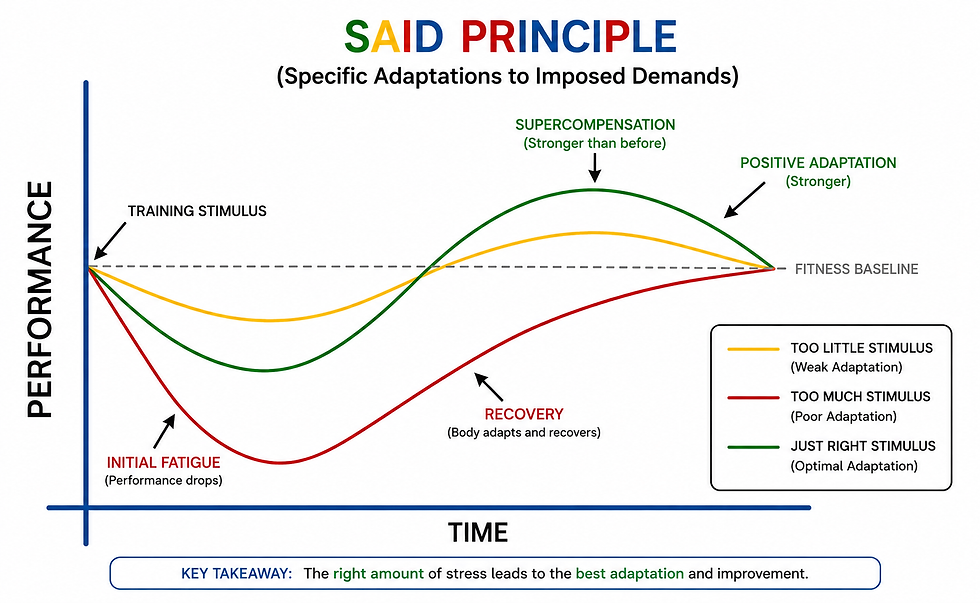
When you rest for prolonged periods after an injury or during chronic pain, a few things happen:
Muscles weaken and atrophy faster than most people realize - studies show significant strength loss can begin within just 2-3 days of immobilization
Joints lose their synovial fluid circulation, which is essentially the lubrication that keeps them moving smoothly
Your nervous system starts to amplify pain signals - a phenomenon called central sensitization
You're not protecting yourself by resting. You're creating the conditions that make recovery harder.
The Research Is Clear On This
The shift away from "rest and protect" toward active recovery isn't new - it's been building in the evidence base for decades. The old RICE protocol (Rest, Ice, Compression, Elevation) has been largely replaced by PEACE & LOVE - a framework that emphasizes education, active movement, and load management from the start.
A landmark study published in JAMA found that for acute low back pain, patients who stayed active recovered faster and experienced less disability than those who rested in bed.
The research on osteoarthritis tells the same story: exercise is consistently more effective than rest for reducing pain and improving function.
Movement is medicine. Literally.
So Why Do We Still Default to Rest?
Because pain is a protective signal. When something hurts, our instinct is to guard it, stop using it, protect it. That instinct makes evolutionary sense - but it doesn't map well onto the reality of how the musculoskeletal system actually heals.
The mistake isn't feeling the urge to protect yourself. The mistake is letting that instinct override the evidence.
Pain doesn't equal damage. In fact, one of the most important things I work to help people understand is that pain intensity is a poor indicator of tissue harm. You can have significant degeneration on an MRI with zero pain. You can have serious pain with nothing structurally wrong at all. The nervous system is far more complex than "pain = injury."
What You Should Do Instead
This doesn't mean push through everything and ignore your body. It means load management - doing enough to promote healing without overwhelming the system.
In practice, that looks like:
Moving within a tolerable range of discomfort - some pain during exercise is acceptable, especially if it settles back down within 24 hours
Starting with gentle, low-load movement and progressively building from there
Targeting not just the painful area, but the full kinetic chain - because your knee pain might be coming from your hips and ankles, not your knee
Keeping the surrounding musculature active to prevent the cascade of weakness that makes everything worse
I've worked with clients who spent months resting a shoulder injury, only to come to me with a frozen shoulder on top of the original problem - because the scar tissue and muscle imbalances had time to compound.
Movement, done correctly, is what breaks that cycle.
Every post I write comes from the same place -- the belief that your body deserves more than a surface-level fix. If you want to understand the full picture of how I approach pain, movement, and lasting wellness, the philosophy page is where it starts.


Comments